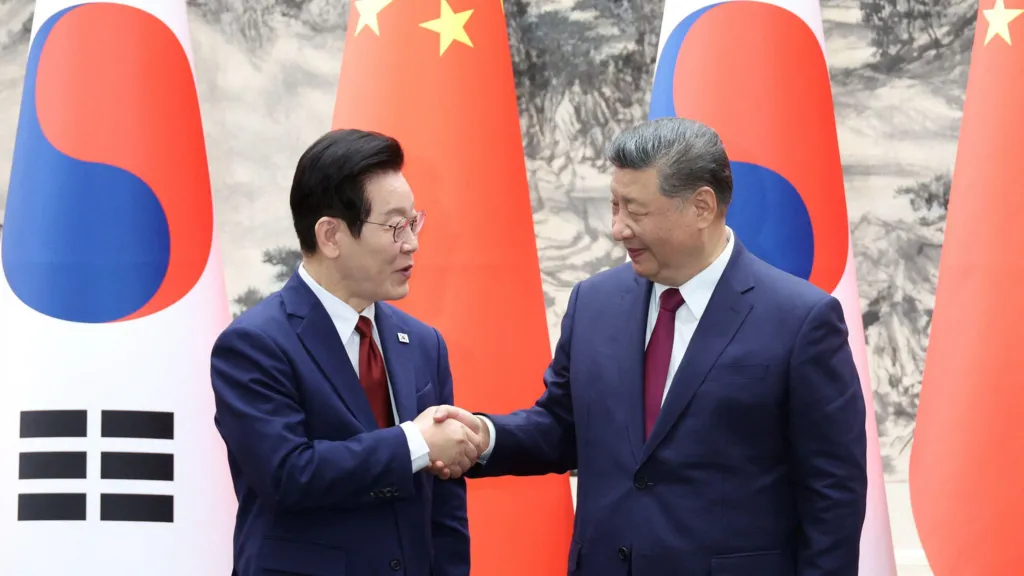
South Korean President Lee Jae Myung is meeting Chinese leader Xi Jinping as part of an effort to repair strained relations with China, the country’s largest trading partner.
The talks, scheduled for Monday, will also cover regional security concerns and China’s unofficial restrictions on Korean pop culture. This will be the leaders’ second meeting since November, when Xi traveled to South Korea.
Given China’s crucial role in South Korea’s economy, analysts say Lee is seeking reassurance that Beijing will not use economic ties as leverage amid rising political tensions in the region.
Tensions between China and Japan over Beijing’s claims on self-governed Taiwan have further complicated the regional landscape, placing South Korea in a delicate diplomatic position.
Beijing has stepped up its criticism of Japan after Prime Minister Sanae Takaichi told parliament that Tokyo could deploy its Self-Defense Forces if China were to attack Taiwan.
Against this backdrop, Lee’s visit to Beijing carries added significance. Like Japan, South Korea is a close US ally, and Washington supports Taiwan and provides it with defensive weapons.
According to state broadcaster CCTV, President Xi Jinping is expected to formally welcome Lee at the Great Hall of the People in Beijing. After the ceremony, Lee will meet Chinese Premier Li Qiang and parliament chairman Zhao Leji before continuing on to Shanghai.
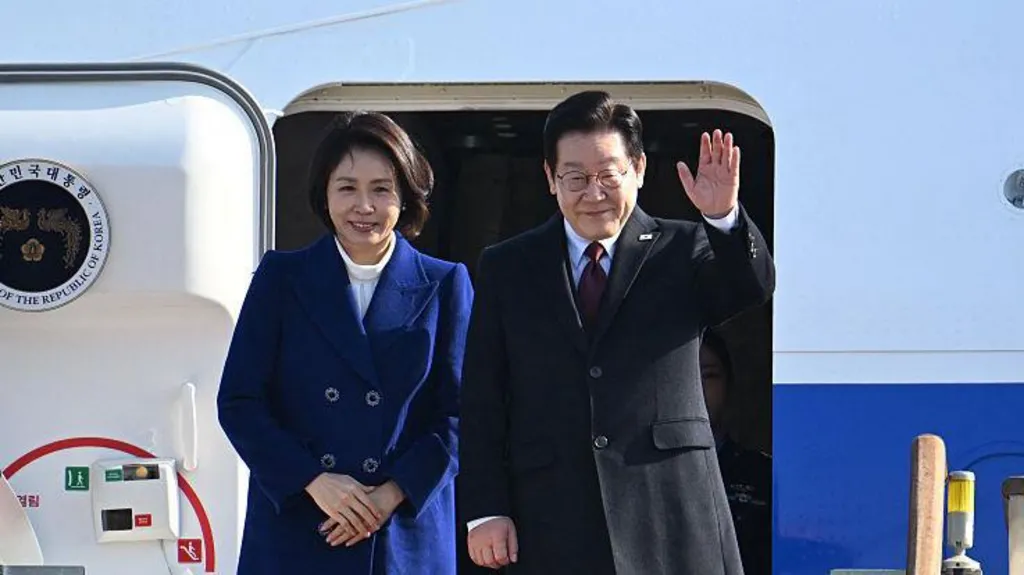
Lee arrived in Beijing on Sunday and told members of the Korean community there that his visit would mark “a new starting point” for repairing strained Korea-China relations, restoring them to normal, and elevating them to a higher level.
This is the first visit by a South Korean leader since 2019. Relations deteriorated under Lee’s predecessor, former president Yoon Suk Yeol, who was impeached and took a strongly critical stance toward China.
Observers say Xi’s willingness to meet Lee also reflects Beijing’s search for regional partners. Park Seung-chan, a professor of China studies at Yongin University, told the BBC that China’s message, while indirect, is clear: it wants South Korea to align with Beijing and distance itself from Japan.
China has also emphasized its shared history with Korea in resisting Japanese rule during the 20th century, Park noted. During his stay in Shanghai, Lee is expected to attend a memorial for Korean independence activists who fought against Japan.
While South Korea continues to show diplomatic caution toward China, it also hopes to strengthen ties with both Beijing and Tokyo, Park added.
Seoul has long tried to balance relations between its two powerful neighbors. Lee is reportedly planning a visit to Japan later this month to meet Takaichi. Meanwhile, South Korea’s national security director Wi Sung-lac said on Friday that Seoul continues to respect the One China policy, acknowledging Beijing as the sole government of China.
